
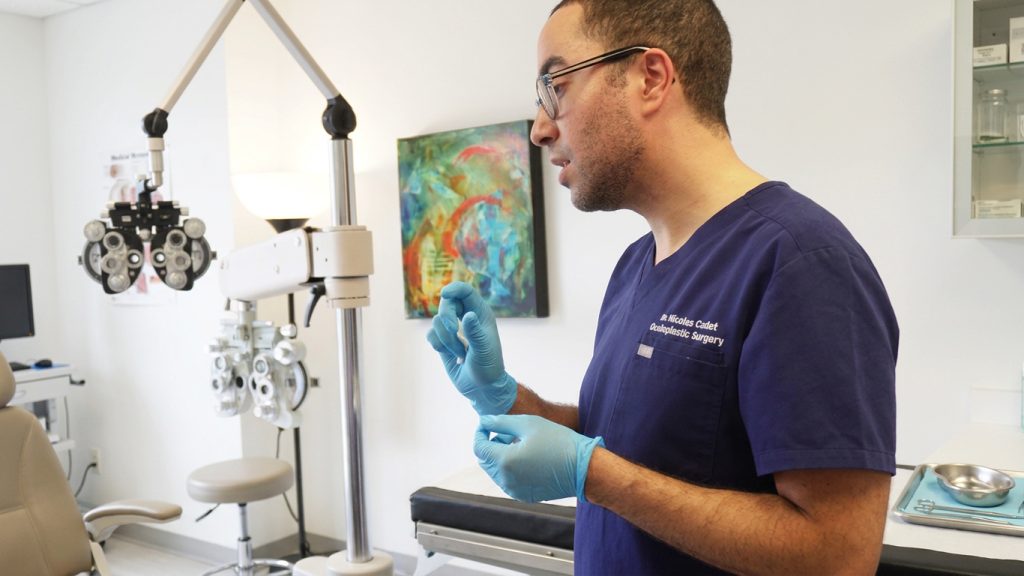
Injections and Dermal Fillers with Dr. Nicolas Cadet
Aesthetic care is a lesser-known side of Clinique d’ophtalmologie Bellevue. Thanks to the expertise of our colleague Dr. Nicolas Cadet, an ophthalmologist and oculoplastic surgeon, we’re able to offer these specialized treatments at our Longueuil and Westmount clinics.
Neuromodulators (Botulinum Toxins) or Dermal Fillers: Which One Should You Choose?
It’s a question we hear often during consultations. Both treatments are given by injection and both aim to rejuvenate the face, so it’s understandable that the difference isn’t obvious. In reality, they work in completely different ways.
Neuromodulators
Neuromodulators, also called botulinum toxins (or cosmetic injections), act on the muscles. They temporarily block the nerve signal that makes the muscle contract. The result? The muscle relaxes, and the wrinkles that form when you move your face soften.
They’re mainly used for expression lines: horizontal forehead lines, crow’s feet at the corners of the eyes, and frown lines, the ones that appear between the eyebrows.
Dermal Fillers
Dermal fillers, on the other hand, don’t affect the muscles. Most are made of hyaluronic acid, a substance our bodies already produce naturally. Once injected, they add volume where it’s lacking.
They’re used to fill a hollow or a wrinkle, enhance the cheekbones or lips, restore volume lost with age, or improve skin hydration and texture.
To put it simply: a neuromodulator relaxes, a filler fills. The first targets wrinkles that appear when you move, while the second addresses those that remain even at rest, as well as the contours of the face.
How Long Do the Results Last?
It depends on the treatment. For neuromodulators, expect an average of three to four months. For dermal fillers, the effect lasts longer: one to two years, depending on the product used and the area treated.
Are There Any Side Effects?
As with any medical procedure, yes, but they’re generally mild and go away on their own within a few days.
After a filler, it’s normal to have some redness, swelling, occasionally a bruise, or tenderness to the touch. Some people also experience slight itching.
With a neuromodulator, you may notice slight redness or a bruise at the injection site. Some people also feel a sense of heaviness or mild weakness in the treated muscle and, more rarely, a headache.
How Do I Book an Aesthetic Consultation at Bellevue?
Dr. Nicolas Cadet will be happy to welcome you to his office for a consultation. To get an appointment quickly, fill out our online form by clicking here.